

As one of the greenest cities on the planet, Vancouver is home to many lush parks, and Queen Elizabeth Park stands out as a popular urban oasis. Learn more about the park’s creation and development on vancouver-name.
Creation of the Park
The history of Queen Elizabeth Park begins in 1954, the year its development was completed. To mark this long-anticipated event, a time capsule was placed beneath the “Rock of Ages,” scheduled to be opened in 2054 on the park’s 100th anniversary.
Before becoming a green haven, the park’s site was a large quarry, evidenced by its distinctive terrain. The quarry was originally used to extract basalt for building the railroads.
The land was first owned by the Canadian Pacific Railway. In 1911, however, the Basalt Quarry was shut down, leaving the 94-acre area unused until 1928. At that time, Vancouver, South Vancouver, and Point Grey (before their amalgamation) purchased the land for $100,000.
Ideas to transform the area into a green space emerged in the 1930s. Two large reservoirs on the site were converted into water storage facilities, laying the foundation for a future park.
In 1939, the first steps toward creating the park were taken when initial landscaping began. King George VI visited the site during this period, and the park was named in honour of his wife, Queen Elizabeth. Two years later, the Queen herself visited the park and planted an English oak tree as her contribution to the park’s development.
Over the next 15 years, the former quarry was gradually transformed into a vibrant landscape filled with greenery. Landscaping efforts culminated in 1954, and five years later, the national park was fully opened to the public.
Subsequent renovations and expansions of the park took place in the 1970s, 1980s, and 2007.
The Exotic Bloedel Conservatory
Around the same time, the unique Bloedel Conservatory was constructed. The project was spearheaded by Prentice Bloedel, a forestry industry magnate, who invested $1.5 million in the creation of this extraordinary attraction.
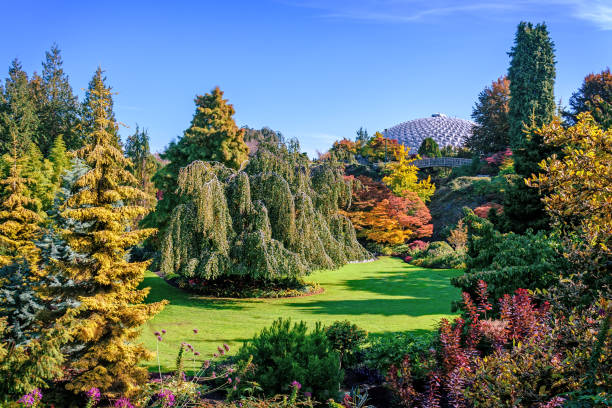
Situated atop Little Mountain, the conservatory is dome-shaped and composed of 1,500 acrylic bubbles. At night, its intricate lighting creates a magical ambiance.
Inside, visitors will find a pond with Japanese koi fish, approximately 500 species of exotic plants, and numerous birds brought from Africa, Australia, and the Americas.
Features of Queen Elizabeth Park
Standing at 152 meters above sea level, Queen Elizabeth Park is Vancouver’s highest point. From here, visitors can enjoy breathtaking panoramic views of the city, picturesque garden trails, water features, and even outdoor theatrical performances.
The park showcases a wide array of regional tree species, including cedars, maples, spruces, ashes, and larches. Visitors can also admire more exotic species like birches, plum trees, and cherry blossoms, which attract tourists during their blooming season. The park’s lawns also change hues with the seasons, adding to its charm.
The park offers a variety of activities, such as lawn bowling and disc golf. For tennis enthusiasts, there are 18 courts on the premises. Those seeking a more relaxed experience can host a picnic on the sprawling green grounds.
The park is also home to a stunning fountain, a wedding pavilion, a restaurant, and a dedicated artists’ corner. Here, artists gather to paint the park’s breathtaking landscapes and occasionally create caricatures upon visitors’ request.
Queen Elizabeth Park is a testament to Vancouver’s commitment to preserving and celebrating nature. Its combination of natural beauty, recreational opportunities, and cultural attractions makes it a cherished part of the city’s green landscape.