

This area has the power to serve as a “gateway” between the present and the historical past, writes vancouver-name. Here, the fresh sea air beautifully harmonizes with charming, timeworn streets and century-old buildings.
We are talking about Steveston, a stunning village near Vancouver. Renowned for its fiery sunsets, docked yachts, historic landmarks, and once-thriving industry, Steveston holds a rich legacy.
Although the industrial prominence of this village belongs to the past, with local businesses no longer operational, this chapter of its history deserves to be remembered.
In this article, referencing redhairtravel, we will explore Steveston’s factories, which once stood as giants of production and innovation.
“A Fishing Hub”
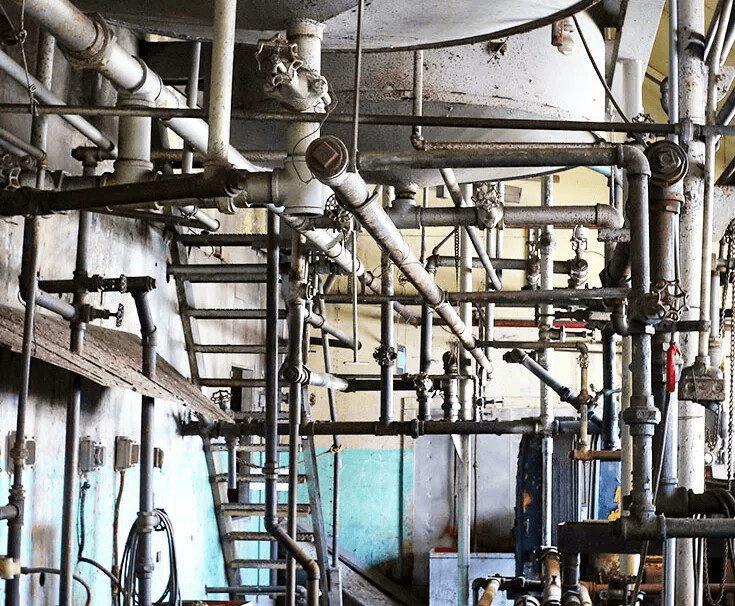
Steveston has always been synonymous with fish, fishing, and fish production. The village derives its name from the Steves family, the first settlers to purchase land at the mouth of the Fraser River. In their honour, the settlement was named Steveston.
The area was a true “fishing centre,” a reputation that shaped its historical trajectory.
“A Fishing Village”
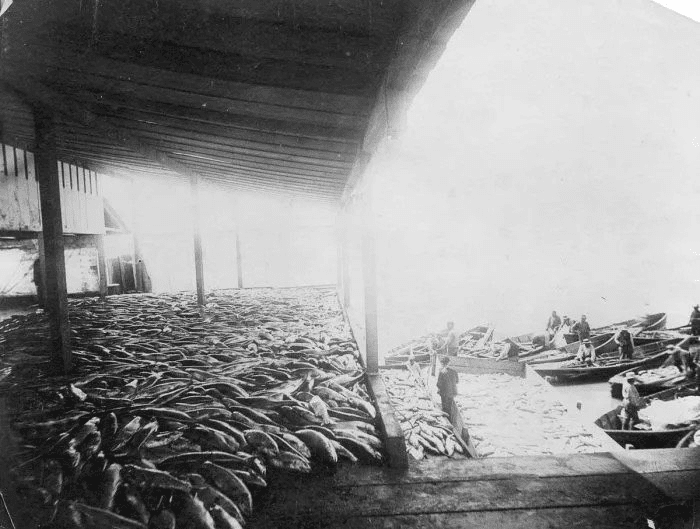
The village’s association with the fishing industry placed its factories at the forefront of its history. Two of the largest and most iconic facilities stood out, leaving an indelible mark on the area’s development.
Phoenix Cannery
The Phoenix Cannery was the first fish cannery to be established in Steveston.
By 1890, it was already fully operational.
The coastal waters teemed with salmon, halibut, and herring, making it almost inevitable for a canning plant to open. As the fishing industry expanded, other canneries joined Phoenix Cannery, earning Steveston the unofficial title of the “Salmon Capital of the World.”
Phoenix Cannery produced goods that were shipped globally. Large vessels were loaded to capacity with its canned products.
Interestingly, the ships carrying goods to international markets often returned with hundreds of workers eager to join the cannery. These workers came from Europe, China, and Japan.
The cannery’s last successful year was 1913. A rockslide caused by railway construction in the Fraser Canyon blocked the river, preventing salmon from reaching their spawning grounds. Although the issue was eventually resolved, the salmon population never fully recovered.
This decline led to the closure of several canneries, including Phoenix Cannery.
Gulf of Georgia Cannery
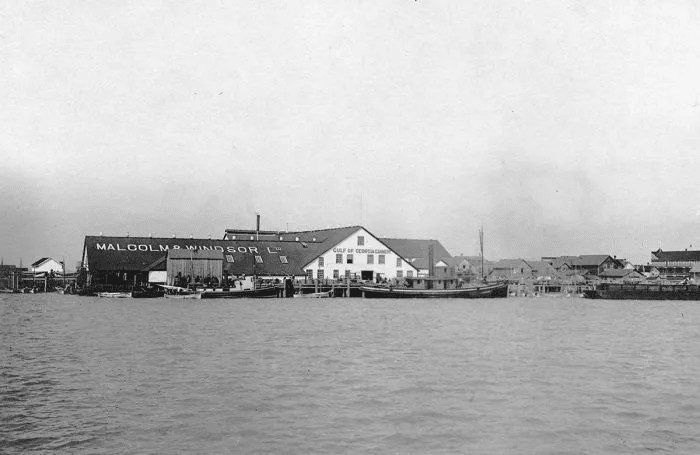
No discussion of Steveston’s factories would be complete without mentioning the Gulf of Georgia Cannery, established in 1894.
Dubbed the “Cannery Monster”, it was the largest facility on the West Coast, employing over 400 workers. The factory processed over 1,000 tonnes of fish annually, much of it by hand under challenging and hazardous conditions.
A grim joke of the time claimed that anyone working at the Gulf of Georgia Cannery was unlikely to retain all ten fingers. This stemmed from the high-speed machinery, which, if not moderated, became dangerous “killing machines.”
The factory was renowned for its comprehensive fish-canning process, which began with unloading, washing, cleaning, and processing the fish. The cleaned fish were then placed in cans, seasoned, sent along conveyor belts, and labelled with the factory’s signature branding.
By 1930, the cannery ceased salmon production, and most of its workshops were converted into storage facilities.
In 1940, the factory began processing herring in response to the surge in demand for inexpensive food during World War II, including canned fish.
The Gulf of Georgia Cannery continued operations until 1979, when it was designated a National Historic Site. A decade later, the facility was transformed into a museum.
Preserving the Legacy
Steveston’s fish factories, such as Phoenix Cannery and Gulf of Georgia Cannery, remain a testament to the village’s vibrant history. While they no longer operate, their legacy continues to shape the cultural and historical identity of this picturesque fishing village.