

It is no secret that British Columbia is one of the regions in Canada where numerous Indigenous peoples once lived, writes vancouver-name. This fact has deeply influenced the historical development of the area and continues to impact its modern state.
Many of British Columbia’s national parks are located on lands that once belonged to various Indigenous communities. Often, a single park encompasses the territories of multiple Indigenous groups, adding layers of historical and cultural complexity. These factors greatly enhance the appeal of such parks, as tourists are often keen to learn about the history and traditions of Indigenous peoples. Their stories are filled with fascinating facts and customs, offering insights into the lives of these communities.
In this article, with reference to pc.gc.ca, we delve into the Pacific Rim National Park Reserve, a place celebrated for its rich history. This park attracts countless visitors and remains a beloved destination for locals, who continue to uncover new details about its creation and significance.
One of the Most Famous Parks
The Pacific Rim National Park Reserve is often regarded as one of Canada’s most renowned national parks. It spans an area of 511 square kilometers.
The park comprises three distinct regions: Long Beach, the Broken Group Islands, and the West Coast Trail. The park’s landscape features rugged coastlines and temperate rainforests shaped by a moderate climate.
Lands of Indigenous Peoples
In 1995, studies began to explore the culture of the Nuu-chah-nulth people, who historically inhabited the area now encompassed by the park. Interestingly, when the park was established, 21 Indian reserves were excluded from its boundaries. These reserves once belonged to seven different Indigenous communities, even though much of the park’s land had traditionally been their territory.
For example, the Long Beach area and the Kennedy Lake watershed were the lands of the Tla-o-qui-aht people.
In the Broken Group Islands, archaeological excavations have uncovered evidence of human activity dating back over 5,000 years. While Benson Island was once the site of a summer village, it was eventually abandoned. Another settlement, Effingham, was destroyed by fire in 1914.
Climate Characteristics
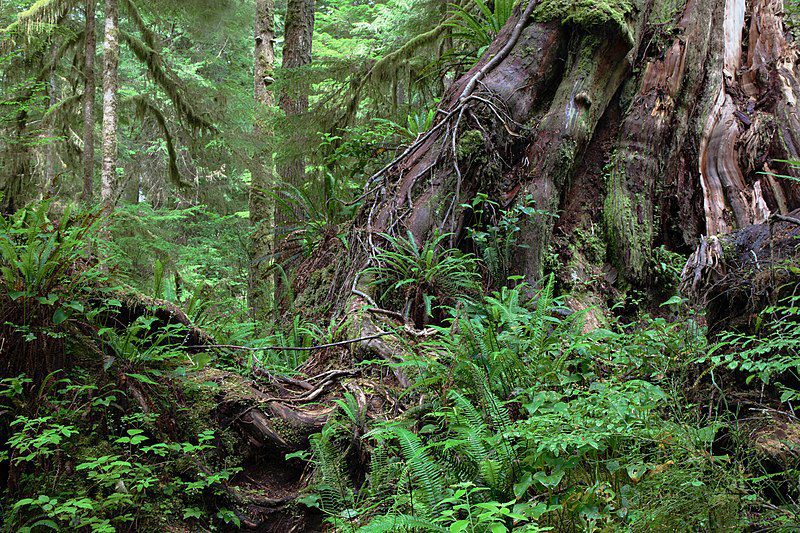
Like the neighboring areas of Tofino and Ucluelet, the park’s climate is heavily influenced by the southwest region’s conditions.
During winter, the area experiences jet streams and low-pressure water currents caused by the Gulf of Alaska. Its cool, moist air masses rise orographically as they pass through the mountainous terrain, resulting in heavy rainfall. Hukuktlis Lake, part of the park, is considered one of the wettest places on Earth.
In winter, the sea temperature averages 8°C, while in summer, it rises to 14°C.
The summer season is characterized by high atmospheric pressure and warmer air masses that trap moisture from the Pacific Ocean, leading to dry and sunny weather.
Summer air temperatures typically range from 5°C to 18°C.