

Park · Vancouver · ⭐ 9.7/10 · 49054 reviews · updated: 2026-08-04 20:18:37
Address: Vancouver, BC V6G 1Z4, Canada
Stanley Park — a thousand acres of rainforest ringed by the sea
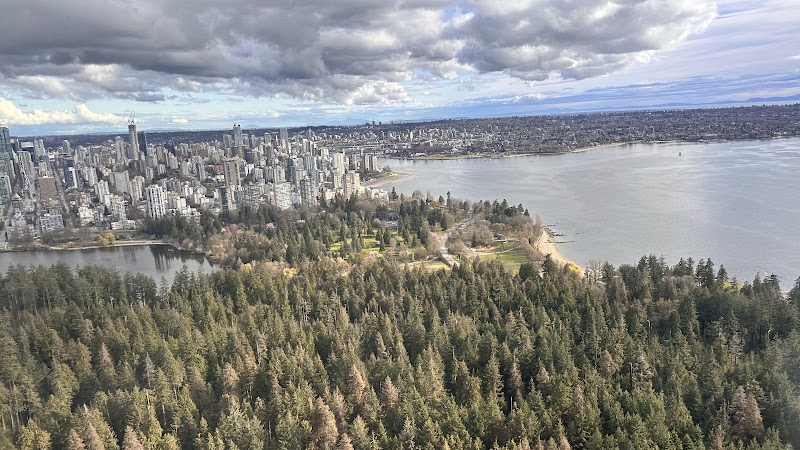
Vancouver keeps its wildest ground at the very tip of downtown. Stanley Park covers 405 hectares — 1,001 acres — on a peninsula that salt water surrounds on almost every side, so that roughly half a million trees, a great blue heron colony and a resident coyote population live a ten-minute walk from office towers. It is not a designed park in the European sense. Most of it is second- and third-growth coastal rainforest of Douglas fir, western redcedar, western hemlock and Sitka spruce, some trees reaching 76 metres, threaded by about 27 kilometres of forest trails. Around the rim runs the seawall, and along the seawall runs most of the city, all summer, in both directions. Roughly eight million visits land here every year — and it is still perfectly possible to have a trail to yourself on a wet Tuesday in February.
Highlights
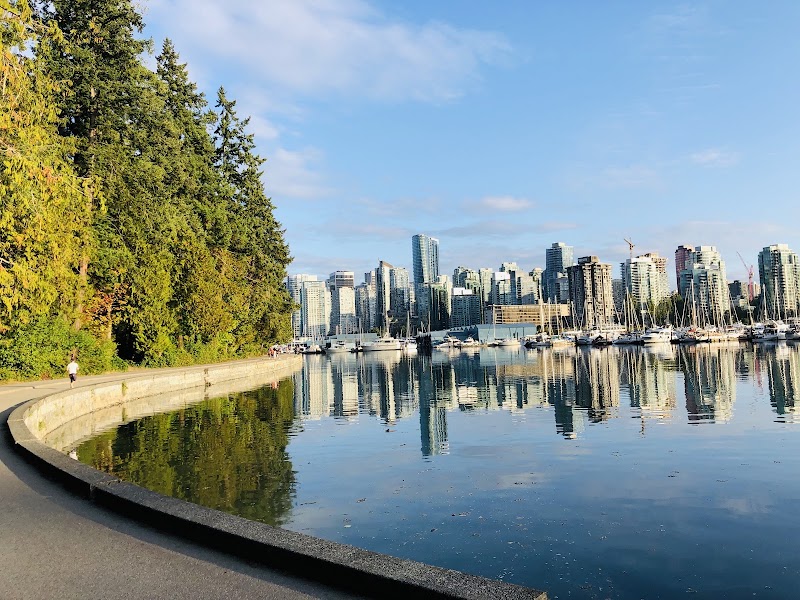
- The Seawall — the park’s own 8.8-kilometre arc of granite waterfront path, begun in 1917 under park superintendent W.S. Rawlings and built largely by master mason James “Jimmy” Cunningham, who worked on it from 1931 to 1963 and kept inspecting it until he died at 85. Walkers have their own lane; bikes, skates and scooters travel one way only, counter-clockwise.
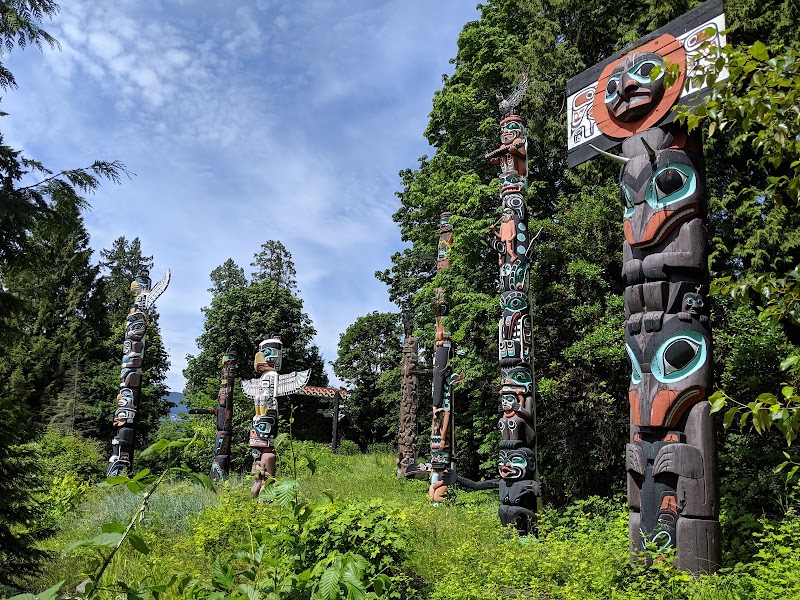
- The totem poles and welcome gateways at Brockton Point — nine poles carved by Kwakwaka’wakw, Haida, Nisga’a and Squamish artists, most of them replicas made after the originals were repatriated or sent to museums, plus three Coast Salish welcome gateways titled People Amongst the People by Musqueam artist Susan Point.
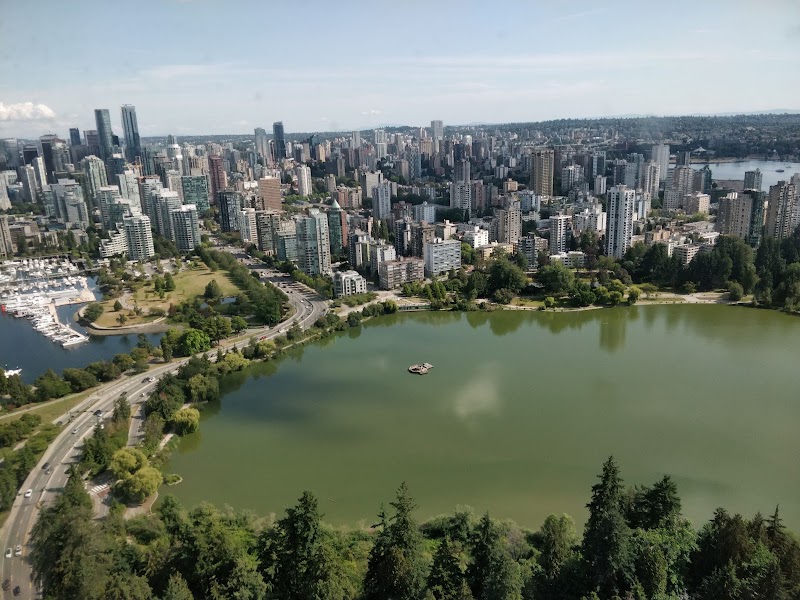
- Lost Lagoon — a tidal arm of Coal Harbour cut off by causeway construction between 1913 and 1916, named by Mohawk poet E. Pauline Johnson because the water vanished at low tide. Its lit Jubilee Fountain, bought from Chicago’s 1933 World’s Fair, has played since Vancouver’s Golden Jubilee in 1936.
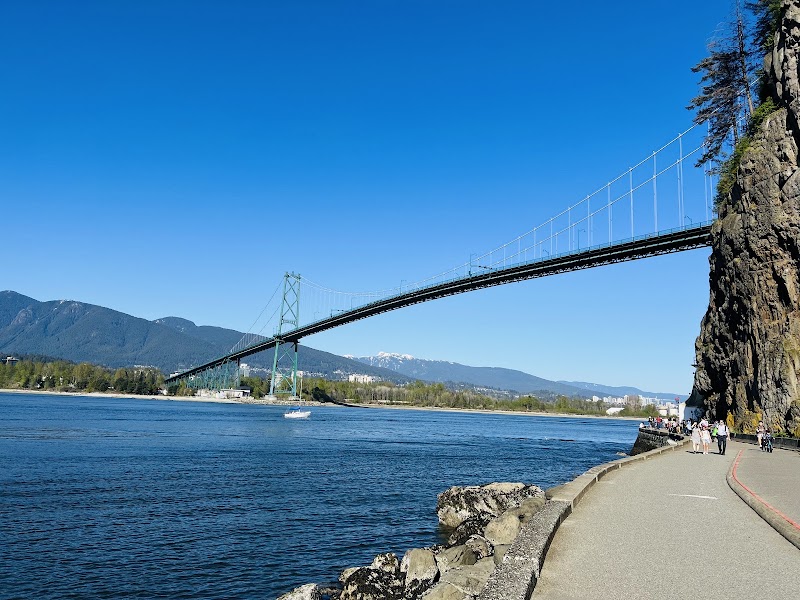
- Prospect Point — the park’s highest ground, on the cliff above the First Narrows, with the Lions Gate Bridge below and the North Shore mountains opposite. A navigation light has burned here since 1 October 1888, four days after the park opened.
- The Hollow Tree — a western redcedar stump between 700 and 800 years old and about 17 metres in circumference, photographed with horse carriages and early motor cars inside it. Condemned for removal in 2008 after storm damage, it was saved by public subscription and re-dedicated on a hidden engineered foundation in October 2011.
- Beaver Lake — a shrinking forest pond, under four hectares and slowly filling in, smothered by ornamental water lilies planted for a royal jubilee in 1938, and fed by Beaver Creek, one of the last free-flowing streams in Vancouver and one of only two where salmon still return to spawn.
What you’ll find
The park works as three overlapping layers: a hard rim of seawall and beaches, a soft interior of rainforest trails, and a scatter of built attractions inherited from a century and a half of civic enthusiasm. You can spend a day here without repeating yourself, and a week without seeing it all.
- Beaches and a heated pool — Second Beach with its outdoor pool and enormous playground, and Third Beach, the quieter and steeper one, known for sunsets and an informal summer drum circle. Lifeguards flagged the swimming areas from 16 May to 7 September in 2026, daily from noon to 8 p.m.
- Gardens — a Rose Garden started by the Kiwanis Club in 1920 and now carrying several thousand bushes under an arbour of climbing roses and clematis, and a Shakespeare Garden whose first tree was planted in 1916 on the three hundredth anniversary of the playwright’s death; its roughly forty-five trees carry plaques with the lines that name them.
- Malkin Bowl — a 2,000-seat open-air theatre built in 1934 as the Marion Malkin Memorial Bowl. Theatre Under the Stars has performed here since 1940; its 2026 season ran Sister Act and Disney’s The Little Mermaid on alternating nights from 3 July to 22 August.
- The Vancouver Aquarium — Canada’s largest, opened on 15 June 1956 and marking its seventieth anniversary in 2026. It is a separate paid attraction inside the free park, and it no longer keeps whales or dolphins.
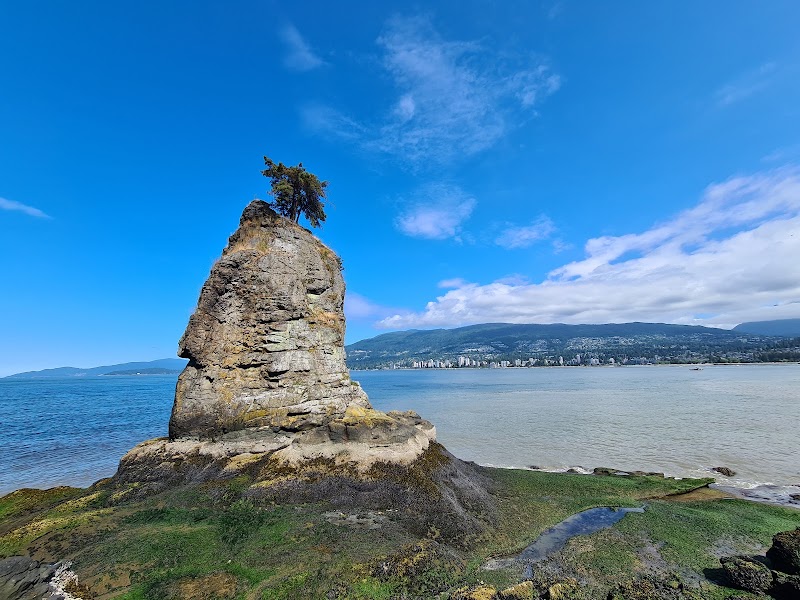
- Small landmarks worth finding — the Nine O’Clock Gun, an 1816 naval cannon that has marked nine in the evening from Brockton Point since the 1890s; Girl in a Wetsuit, Elek Imredy’s bronze unveiled offshore on 10 June 1972; and Siwash Rock, the sea stack the Squamish call Slhx̱i7lsh, “he is standing up”, with a small fir growing from its crown.
- Wildlife — around 200 bird species, a great blue heron colony that settled in the park in 2001 and has grown to roughly 170 nests, beavers, raccoons, coyotes, and grey squirrels descended from eight pairs shipped from New York’s Central Park in 1909.
Things to do — and who it’s for
- First-time visitors — walk or cycle the full seawall loop: roughly two hours on foot, about an hour on a bike, with the totem poles, Prospect Point, Siwash Rock and Third Beach strung along it in order.
- Families with small children — the Second Beach pool and playground, the water spray park near Lumberman’s Arch that replaced a 1930s saltwater pool in 1987, and the flat, stroller-friendly path around Lost Lagoon.
- Runners and cyclists — a marked, largely flat circuit with sightlines to open water the whole way, plus a hillier alternative on the interior trails when the seawall is crowded.
- People who came for the forest — the interior trail network away from the rim, where the noise drops within a hundred metres and the canopy closes overhead; this is also where the hemlock looper damage and the replanting are most visible.
- History and culture travellers — Brockton Point for the poles and gateways, the Chaythoos plaque near Prospect Point laid at the park’s centennial in 1988, and the Japanese Canadian War Memorial with its two rows of cherry trees.
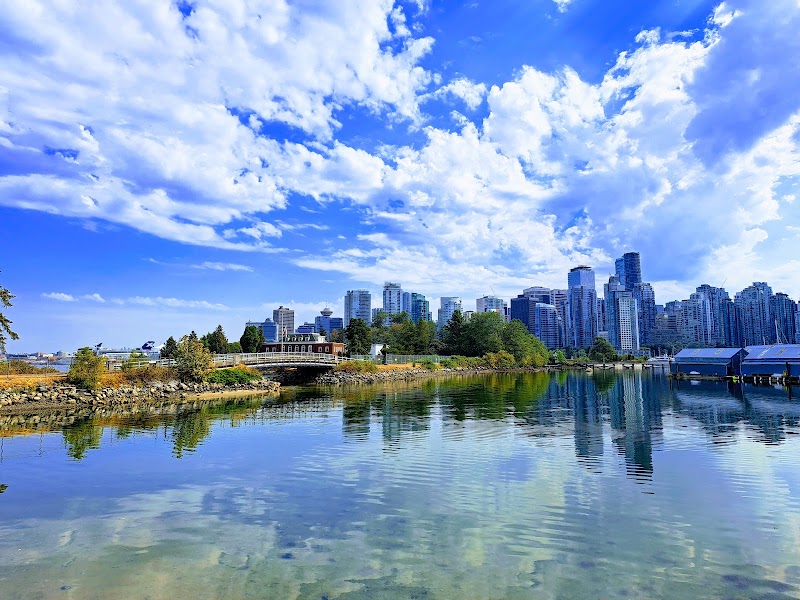
- Photographers and sunset chasers — Prospect Point for the bridge and mountains, Third Beach for the light going down over the Strait, and the Coal Harbour side at dusk for the downtown skyline across the water.
Getting there & practical
The park occupies the northwestern end of the downtown peninsula, directly beyond the West End. On SkyTrain, the closest stations are Burrard and Waterfront on the Expo Line; Waterfront is also the terminus of the Canada Line and the SeaBus to the North Shore, which makes it the natural arrival point for anyone coming from Richmond, the airport or North Vancouver. From either station it is a walk of twenty to thirty minutes to the park entrance, or a short connection by bus. Route 19 is the only bus that actually enters the park, running from Metrotown Station to the Stanley Park Loop near the Aquarium; in 2026 its seasonal park service ran from 8 June to 6 September. Routes 5 and 6 bring you to the West End edge, from which the seawall begins. Entry to the park itself is free and there are no gates or opening hours — the seawall and roads are open around the clock, and the trails are best used in daylight. The Vancouver Aquarium charges its own admission, as does the Second Beach pool during its season; parking inside the park is paid, and in summer it fills early. The miniature railway has not operated since a safety incident in December 2024 and did not run in 2026 while the Park Board looks for a new operator; a temporary eighteen-hole mini-golf course opened on the train site on 1 July 2026 and runs into the autumn. Horse-drawn carriage tours of the eastern side operate through the warm months. Allow half a day at minimum; a full day if you intend to include the Aquarium or a beach.
When to visit
Vancouver’s climate is genuinely two seasons wearing four names, and the park changes character with them. Summer is dry, long-evening and busy: July and August bring warm water at Second and Third Beach, lifeguards on duty, Theatre Under the Stars at Malkin Bowl, and a seawall so crowded on weekend afternoons that early morning is the only quiet window. Autumn is arguably the best compromise — the crowds thin after Labour Day, the bigleaf maples turn, the salmon head up Beaver Creek, and the first storms come in off the Strait to hammer the west-facing shore, which is why the Park Board schedules its annual slope-stabilization closure between Third Beach and Prospect Point for late November. Winter is wet rather than cold: rain most days, snow rarely and briefly, temperatures usually above freezing, and a forest that turns luminous green with moss. Bring waterproofs and you will have the interior trails almost to yourself. Spring arrives early by Canadian standards — cherry blossom in March, the heron colony noisy and rebuilding by April, the Rose Garden building towards its June peak. If you want one recommendation: late May and September combine warm light, open water and manageable crowds.
Good to know
This land is the unceded territory of the Musqueam, Squamish and Tsleil-Waututh peoples, and it was inhabited long before it was a park — archaeological evidence puts human use here at more than 3,000 years. Two village sites are central to its history. X̱wáyx̱way, roughly “place of masks”, stood where Lumberman’s Arch is now, and included a longhouse measured at some 61 metres by 18; Chaythoos, “high bank”, lay to the west near Prospect Point. The peninsula was set aside as a military reserve in 1863, logged by six different companies between the 1860s and 1880s, and then, when Vancouver incorporated in 1886, leased to the new city as a park. It opened on 27 September 1888 and was dedicated in 1889 by Frederick Stanley, 16th Earl of Derby, in words that promised it “to the use and enjoyment of peoples of all colours, creeds and customs”. The promise was not kept for the people already living there. In 1888 residents were forced out so that the perimeter road could be built, and shell middens were crushed for road surfacing. August Jack Khatsahlano, born at X̱wáyx̱way or Chaythoos in 1877 and later a chief of both Squamish and Musqueam descent, remembered surveyors cutting straight through his family’s house; his father’s grave sat beside the new road for years before the coffin was moved north to Squamish. He told those memories to Vancouver’s first city archivist, Major J.S. Matthews, and they were published as Conversations with Khahtsahlano, 1932–1954. In 1889 a Chinese settlement at Anderson Point was cleared and its buildings burned by park staff. Sexwalia “Aunt Sally” Kulkalem lived on at X̱wáyx̱way until her death in 1923, after which her heir sold the property. The remaining Brockton Point families fought the city in court and lost at the Supreme Court of Canada in 1925; most were evicted by 1931, and the very last resident, Tim Cummings, stayed on until 1958. In 2010 Squamish leadership proposed renaming the whole park X̱wáyx̱way. The park has since been designated a National Historic Site of Canada, in 1988, and it carries a Chaythoos plaque laid the same year. Two more recent events have reshaped the forest. On 15 December 2006 a windstorm with gusts to 115 km/h took down an estimated 10,000 trees, damaged around 40 per cent of the forest and destabilized long stretches of seawall, triggering a restoration bill of roughly $9 million. Then between 2019 and 2022 an outbreak of the hemlock looper — a moth native to British Columbia whose populations surge every 11 to 20 years for about three years — killed not only western hemlock but Douglas fir, grand fir and western redcedar across large areas. The Park Board’s mitigation program has been contentious, with public protests against the scale of the cutting: around 11,000 dead or dying trees have been removed across all phases for public-safety reasons. The third and final phase began on 13 January 2026, with removals scheduled in the first and fourth quarters of the year along Lees Trail, Lovers Walk, Tatlow Trail and the paths around Beaver Lake, and periodic daytime trail closures. On the replanting side, more than 54,000 seedlings of diverse species have gone in, supported by a three-year donation from Western Forest Products, with over 22,000 native trees planted in spring 2026 alone; 58 per cent of the affected forest has now been treated and replanted. The seawall itself is fully open: a storm-damage closure between Ferguson Point and Prospect Point ran 26–30 January 2026 and reopened ahead of schedule on 29 January.
Visitor tips
- Ride the seawall counter-clockwise. It is not a suggestion — wheeled traffic is one-way, and going against it in July is both illegal and genuinely dangerous.
- Check the Park Board’s notices before planning an interior route in winter. Hemlock looper removals resume in the fourth quarter of 2026 and bring rolling daytime closures on Lees, Tatlow, Bridle, Cathedral and Rawlings trails and around Beaver Lake.
- Coyotes live here and have bitten people — there were around 40 incidents between December 2020 and August 2021. Never feed them, keep dogs leashed, and give any coyote a wide berth rather than photographing it.
Questions & answers
Is there an entrance fee for Stanley Park? No. The park, its beaches, the seawall and all the trails are free and open at any hour. Only specific attractions inside it charge — the Vancouver Aquarium, the Second Beach pool in season, the pitch and putt, horse-drawn tours and the seasonal mini-golf — and parking inside the park is paid.
How long does it take to go around the seawall? The park’s own section is 8.8 kilometres. Walking the full loop takes about two hours at an unhurried pace, cycling about one. Add time for Brockton Point, Prospect Point and a beach stop, and half a day is realistic.
Whose land is Stanley Park on? It is unceded territory of the Musqueam, Squamish and Tsleil-Waututh Nations. Villages stood at X̱wáyx̱way and Chaythoos; families were removed from 1888 onward, lost their court case at the Supreme Court of Canada in 1925, and were evicted through the 1930s. The last resident, Tim Cummings, remained at Brockton Point until 1958.
Are the totem poles at Brockton Point authentic? They are authentic carvings, but most are replicas or later works rather than the originals. The collection began in the 1920s with poles bought from Alert Bay and grew for the city’s 1936 Golden Jubilee; several originals were later repatriated — the Skedans mortuary pole went home to Haida Gwaii — or moved to museums. Nine poles now stand at Brockton Point, alongside Susan Point’s three Coast Salish gateways.
Why are so many trees being cut down? Because a hemlock looper outbreak between 2019 and 2022 killed them and dead trees beside busy trails fall. Roughly 11,000 dead or dying trees have been removed, the final phase started on 13 January 2026, and replanting has put in over 54,000 seedlings so far, including more than 22,000 native trees in spring 2026. The scale of the cutting has drawn public protest.
Is the seawall open, or are parts closed? It is fully open. The most recent significant closure, between Ferguson Point and Prospect Point for winter storm repairs, ran 26–30 January 2026 and finished early. Expect a short annual closure for slope stabilization between Third Beach and Prospect Point in late November.
Is the miniature train running? No. It has been out of service since a safety incident in December 2024 and did not operate in 2025 or 2026 while the Park Board seeks a new operating partner. A temporary eighteen-hole mini-golf course opened on the train site on 1 July 2026, and the Bright Nights Christmas event has permanently moved elsewhere.
Can you swim in the park? Yes, at Second and Third Beach, and in the heated outdoor pool at Second Beach. In 2026 the lifeguarded beach season ran 16 May to 7 September with flagged swimming areas from noon to 8 p.m., and the Second Beach pool season ended on 7 September.
Photos
Show 1 more photos
Visitor reviews
Reviews last updated: 2026-08-04 20:18:37
Data is refreshed monthly. Sources: vancouver-name.com and editorial picks based on reviews.
Great place, super for the family.
Nice, interesting with the kids, I reckon it's worth the money. On a weekend it's almost $50 for an adult and $30 for a child.
A very beautiful park that has a great location and everything you need for a comfortable time off ❤️
Big. You can walk around all day.