

Park · Vancouver · ⭐ 9.5/10 · 15386 reviews · updated: 2026-08-04 20:18:38
Address: Vancouver, BC V5Y 2N3, Canada
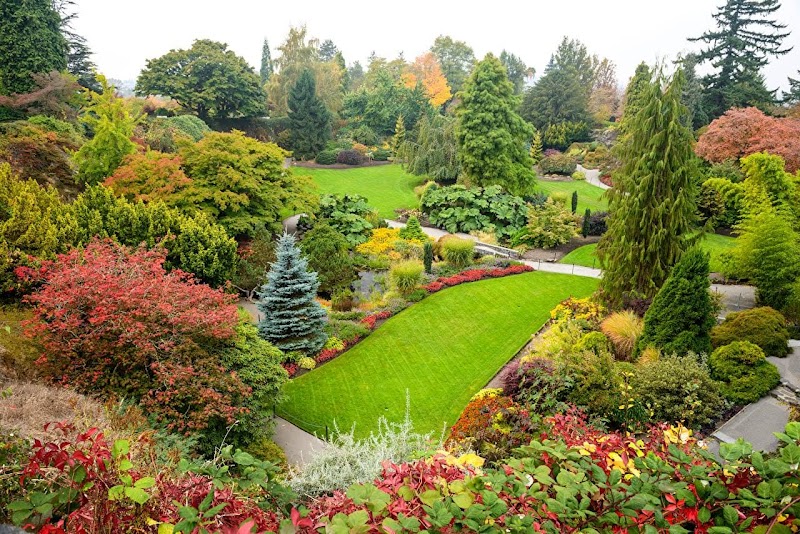
Queen Elizabeth Park — a quarry turned into the city’s rooftop garden
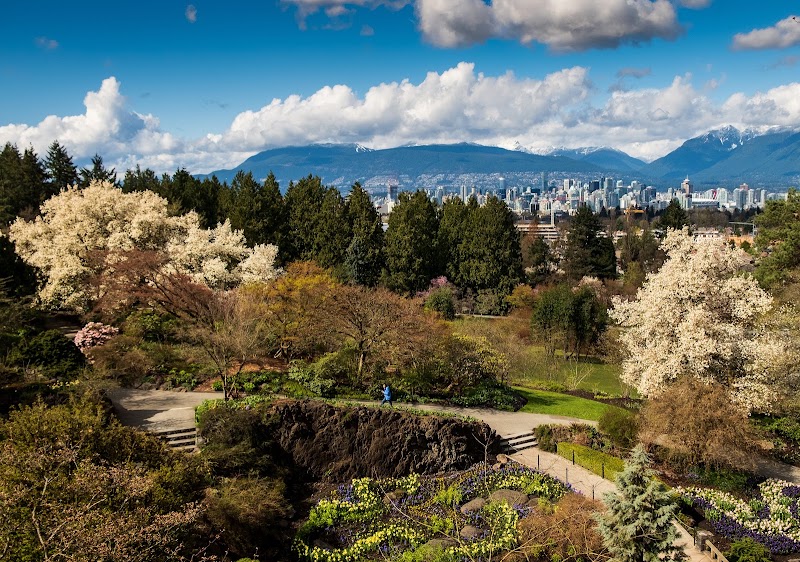
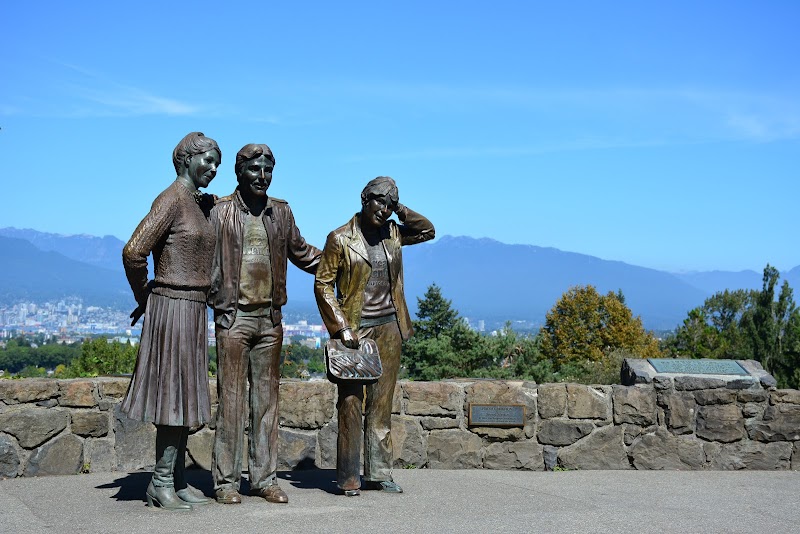
Vancouver’s highest ground is not a mountain but a stump of volcanic rock the locals still call Little Mountain, and the city’s most photographed garden sits inside the hole that was blasted out of it. Queen Elizabeth Park covers about 52 hectares of lawn, arboretum and formal planting, rising to a plaza that the City describes as the highest point in Vancouver — usually quoted at around 152 metres above sea level, though survey figures for the natural summit run closer to 125. From that plaza the downtown towers line up against the North Shore mountains, which is why there is almost always a wedding party in the frame. Below it, two worked-out basalt quarries have been turned into sunken gardens with waterfalls and a stone bridge, and above it a plexiglass dome from 1969 keeps a rainforest and a hundred free-flying birds alive all winter.
Highlights
- The Quarry Gardens — two abandoned basalt pits replanted as sunken gardens, designed by Park Board deputy superintendent Bill Livingstone and unveiled in the early 1960s, with rock walls, a waterfall, a pond and a stone bridge that is the single most photographed spot in the park.
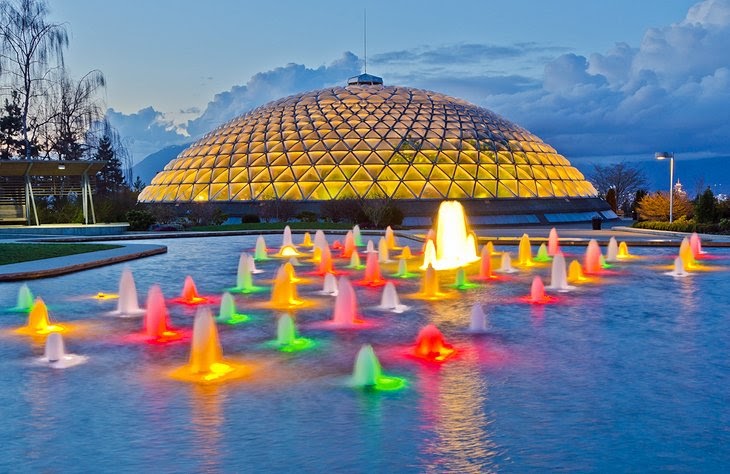
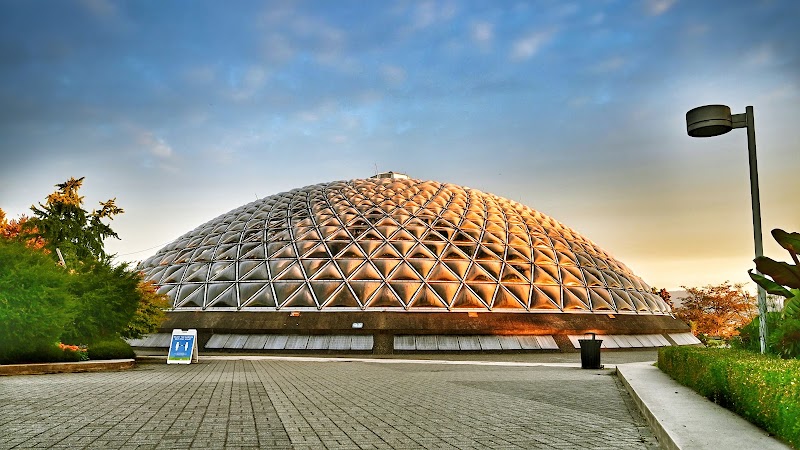
- Bloedel Conservatory — a triodetic dome opened on 6 December 1969, about 43 metres across and 21 metres high, assembled from 1,490 plexiglass bubbles on 2,324 aluminium tubes. Inside are roughly 500 plant species across tropical rainforest, subtropical and desert zones, plus more than a hundred free-flying tropical birds and a koi pond. It is separately ticketed.
- Knife Edge Two Piece — Henry Moore’s monumental bronze, cast from the 1962–65 work, given by Prentice and Virginia Bloedel and installed in 1969. Only three full-size casts exist: this one, one on College Green in Westminster, and one at Kykuit in New York State.
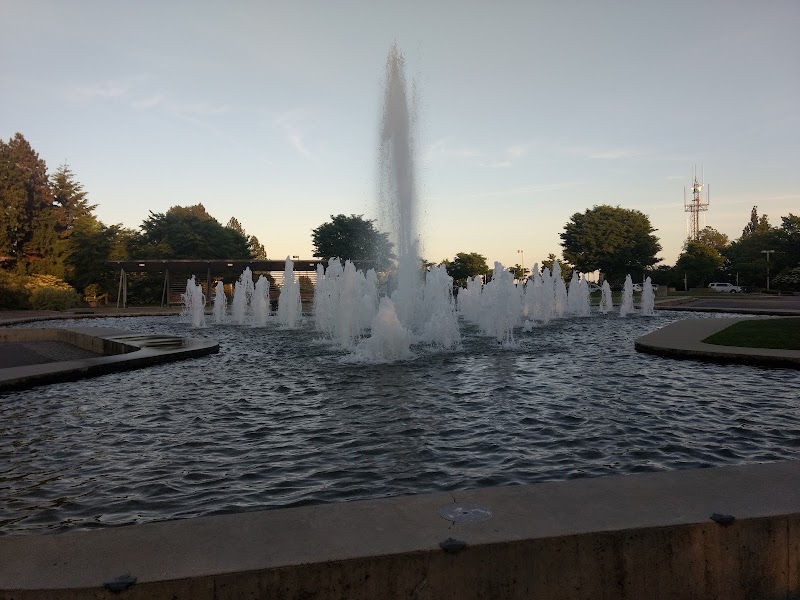
- The summit plaza and Dancing Waters fountain — the city’s highest public viewpoint, with a fountain of about seventy jets in front of the dome and an uninterrupted sweep from downtown to the mountains.
- Canada’s first civic arboretum — begun in 1949 on the north slope by a group of Junior Forest Wardens and now more than 1,500 trees from across Canada and around the world, including a specimen planted by the then Princess Elizabeth in 1951 that is now full grown.
- Seasons in the Park — the hilltop restaurant where Bill Clinton and Boris Yeltsin had dinner on 3 April 1993 at the Vancouver Summit hosted by Brian Mulroney, their first face-to-face meeting; a plaque marks the table.
What you’ll find
The park is laid out as a spiral: sports fields and courts around the base, arboretum on the slopes, formal gardens in the old quarries, and the viewpoint, dome and restaurant on top. Almost all of it is paved or firm-surfaced, which makes it one of the easiest large parks in the city to walk with a stroller or a wheelchair.
- Formal and seasonal planting — the quarry gardens, a rose garden that peaks in mid-to-late June, and rotating displays that keep something in flower from the first bulbs in March to the last dahlias in October.
- Sport at the foot of the hill — tennis courts, lawn bowling, a disc golf course, and an eighteen-hole pitch and putt where no hole exceeds 110 yards, generally open from March into November.
- Two viewpoints, not one — the main plaza by the Conservatory for the skyline, and the quarry lookout on the rim, where a Love Locks sculpture collects padlocks, for the gardens below.
- The Celebration Pavilion — a bookable hall used for weddings and civic events, which together with the plaza makes this the busiest wedding-photography park in Vancouver.
- Painters Corner — an outdoor pitch where local artists sell work in the warmer months, a small tradition that has run for decades.
- Neighbours worth combining — Nat Bailey Stadium, home of minor-league baseball, sits at the base of the hill, and VanDusen Botanical Garden — which now runs the Conservatory — is a short trip away.
Things to do — and who it’s for
- Anyone with two hours and one camera — walk up through the arboretum, drop into the quarry gardens, cross the stone bridge, finish at the plaza for the skyline. That circuit is the park in miniature.
- Visitors in bad weather — the Conservatory is the best wet-day destination in the city: 500 plant species and a hundred birds in a warm dome while it rains on the glass above you.
- Gardeners and plant people — Canada’s first civic arboretum, more than 1,500 labelled trees, and formal beds that are re-planned every season by Park Board horticulturists.
- Families — pitch and putt short enough for children, disc golf, wide lawns, easy paved loops, and a dome full of loud parrots as the reward at the top.
- Couples and wedding parties — the plaza, the quarry bridge and the Celebration Pavilion, in that order; if you want the viewpoint without a queue of photographers, come before nine in the morning.
- People who want the view without the hike — this is the one high viewpoint in Vancouver you can reach by city bus and a short walk, with a restaurant and washrooms at the top.
Getting there & practical
The park sits on Little Mountain in central Vancouver, in the Riley Park–Little Mountain area, roughly midway between downtown and the Fraser River. The simplest approach by transit is the Canada Line to King Edward Station, then a short bus ride or a walk of about fifteen minutes up the hill; buses on the cross-town route along the park’s southern edge, including route 33, drop you closer to the summit, and route 15 runs along the corridor from downtown. From downtown the whole trip takes roughly twenty to twenty-five minutes. Entry to the park is free and the grounds have no gates — the gardens and viewpoints are open around the clock, though the quarry gardens are best in daylight. The Bloedel Conservatory charges its own admission and keeps its own opening hours, generally daily but shorter in winter than in summer; the pitch and putt, tennis courts and Celebration Pavilion are also paid or bookable. Parking on the hill is paid and fills on summer weekends and on any evening with good light. Most main paths are paved with accessible entrances and washrooms near the major attractions, though the quarry gardens involve slopes and steps in places. Allow ninety minutes for the gardens and viewpoint, or half a day if you add the Conservatory and a meal.
When to visit
Spring is the park’s showpiece: bulbs from March, flowering cherries and magnolias through April, and the quarry gardens at their most theatrical in May, when the rhododendrons come out against black rock. Summer brings the roses to their peak in mid-to-late June, long dry evenings ideal for the plaza view, Painters Corner in operation and the pitch and putt busy from morning. It also brings the crowds and the wedding traffic, so early morning is the calm window. Autumn is the arboretum’s season — more than 1,500 trees, many of them chosen for foliage, turning through October and into November, with fewer people and cleaner air after the summer haze. Winter is wet and mild rather than snowy, and it is precisely when the Conservatory earns its keep: a warm dome with a rainforest inside it, twenty-something degrees and loud with birds, while grey rain runs down the plexiglass. Vancouver’s dry season runs roughly July to September and its wet season the rest of the year, so plan the outdoor gardens for the former and the dome for the latter.
Good to know
Before any of this the hill carried old-growth forest and salmon-bearing creeks, with elk, wolves and bears; settlers cleared the trees from the 1870s and the streams were culverted. The Canadian Pacific Railway, which owned the land, opened a basalt quarry here that worked from about 1890 to 1911, and the stone went into the roads of Gastown, Shaughnessy and South Vancouver — a large share of early Vancouver’s street surface literally came out of this hole. In the 1920s one of the exhausted pits was converted into a water reservoir for the growing city; it stayed in use until 1963, when it was covered over and a parking lot laid on top. The City of Vancouver bought the hill from the CPR in 1929, the same year it amalgamated with the municipalities of South Vancouver and Point Grey, and for a decade it sat as scarred, unplanted ground. The turning point came in 1936, when the BC Tulip Association proposed making sunken gardens inside the abandoned quarries. In 1939 King George VI and Queen Elizabeth visited Vancouver, the park was dedicated during the royal tour, and from 1940 it carried the name of the Queen consort — the woman later known as the Queen Mother, not her daughter. Planting followed in stages: the arboretum began in 1949 when a group of Junior Forest Wardens put the first trees into the north slope, creating what is generally called Canada’s first civic arboretum; in 1951 the then Princess Elizabeth planted a tree here on her Canadian tour, and it now stands full size. The quarry gardens themselves were designed by Park Board deputy superintendent Bill Livingstone and unveiled in the early 1960s. The park’s defining structure arrived at the end of that decade. Prentice Bloedel, of the coastal forestry family, gave $1.25 million — the largest donation the city had received up to that point — to build a conservatory on the summit, and Bloedel Conservatory opened on 6 December 1969 with a dedication to a better understanding of the world of plants. Its triodetic dome, designed by McKinley Underwood in the wake of Buckminster Fuller’s dome at Expo 67, spans about 140 feet and rises about 70, and is built from 1,490 plexiglass bubbles carried on 2,324 pieces of extruded aluminium tubing, with eight air-circulation units and twenty-four mist sprayers holding three climates steady. Prentice and Virginia Bloedel, serious art collectors, also gave Henry Moore’s Knife Edge Two Piece, installed in 1969. The dome nearly did not survive: in November 2009 the Park Board voted to close it over an annual operating shortfall of about $240,000, and only a public campaign by the Friends of the Bloedel Association and a partnership with the VanDusen Botanical Garden Association reversed the decision, with the merger approved unanimously on 20 September 2010. One more date belongs to this hill. On 3 April 1993 the hilltop restaurant hosted the working dinner of the Vancouver Summit — Bill Clinton and Boris Yeltsin meeting face to face for the first time, with Prime Minister Brian Mulroney as host, over Dungeness crab, salmon, blueberries and maple ice cream. The plaque is still on the table.
Visitor tips
- Come early for the viewpoint. From late morning the plaza is a working set for wedding and graduation photography, and on summer weekends the parking fills before noon.
- Save the Conservatory for rain. It costs money and takes forty-five minutes, and it is far better value on a wet December afternoon than on a hot July one.
- Approach the quarry gardens from the top and leave from the bottom. The descent past the waterfall and stone bridge is the composed view; walking it uphill puts your back to it the whole way.
Questions & answers
Is Queen Elizabeth Park free? Yes. The gardens, arboretum, viewpoints and lawns cost nothing and have no closing time. The Bloedel Conservatory is a separate paid attraction with its own hours, and the pitch and putt, tennis courts and event pavilion are also paid or bookable. Parking on the hill is paid.
Is it really the highest point in Vancouver? The City treats it as the city’s highest point, and the plaza is certainly the highest publicly accessible viewpoint. The figure usually quoted is about 152 metres above sea level, although survey data for the natural summit of Little Mountain give a lower number, closer to 125 metres. Either way, nothing else in the city looks down on it.
Which queen is it named after? Queen Elizabeth the Queen Mother — consort of King George VI — not Queen Elizabeth II. The couple visited Vancouver in 1939 and the park was dedicated during that royal tour, carrying the name from 1940. Her daughter, then Princess Elizabeth, planted a tree here separately in 1951.
What is inside the Bloedel Conservatory? Roughly 500 plant species arranged across tropical rainforest, subtropical and desert zones, more than a hundred free-flying tropical birds, koi, and a permanently warm climate held by eight air-circulation units and twenty-four mist sprayers. The dome, opened on 6 December 1969, is about 43 metres across and 21 metres high.
Why is there a quarry in the middle of a garden? Because the garden was built inside the quarry. The CPR extracted basalt here from roughly 1890 to 1911 for road-building in Gastown, Shaughnessy and South Vancouver. The BC Tulip Association proposed sunken gardens in the empty pits in 1936, and the design by Bill Livingstone was unveiled in the early 1960s.
Is the park accessible for wheelchairs and strollers? Largely yes. Most main paths are paved, and there are accessible parking, entrances and washrooms serving the major attractions. The quarry gardens are the exception in places, with slopes and steps, though the upper rim path gives the same view without them.
How do I get there by public transport? Take the Canada Line to King Edward Station and either walk up the hill in about fifteen minutes or connect by bus; route 15 runs along the corridor from downtown and route 33 crosses the city along the park’s southern side. The whole trip from downtown takes twenty to twenty-five minutes.
Is there anywhere to eat? Yes — Seasons in the Park sits on the summit beside the plaza and is the restaurant where Bill Clinton and Boris Yeltsin dined on 3 April 1993 during the Vancouver Summit. There is also a café at the Conservatory. Book ahead in summer, particularly for a window table at sunset.
Photos
Show 1 more photos
Visitor reviews
Reviews last updated: 2026-08-04 20:18:38
Data is refreshed monthly. Sources: vancouver-name.com and editorial picks based on reviews.
Come here and enjoy an amazing park. There are plenty of great reviews here, and the vast majority of them are enthusiastic, and quite rightly so. From the Bloedel Conservatory to the open-air gardens and the walking tra…
There's a wonderful view of the city from here, a nice place, you can walk a lot, go and have a look at the parrots
A wonderful park, beautiful roses.
Queen Elizabeth Park in Vancouver is a wonderful place that offers a blend of natural beauty and recreational opportunities. One of its highlights is the Bloedel Conservatory, where admission costs about 8 Canadian dolla…