

Canada is a country where environmental efforts are highly prioritized, writes vancouver-name. Various organizations, communities, and initiatives aim to increase public awareness of ecological issues and draw greater attention to environmental protection.
Vancouver is rightfully known as the greenest city, not only within Canada but also on a global scale. Both the city’s government and its residents are making every effort to turn Vancouver into the most environmentally oriented metropolis. Conferences, campaigns, and symposia are regularly held to support this vision. Additionally, Vancouver places a strong emphasis on scientific research, with scientists often developing innovative technologies that elevate the city’s environmental sustainability.
In this article, referencing msd.com, we will discuss one of Vancouver’s most significant eco-innovations: environmentally friendly asphalt.
The Origins of the Development
Nearly the entire world agrees that Vancouver is one of the most livable cities on the planet.
Rather than comparing itself to other cities, Vancouver’s approach focuses on surpassing its past achievements while striving for ideal environmental standards.
This strategy has proven to be highly effective. Vancouver continues to impress with the number of successfully implemented projects, many of which are based on major technological advancements in sustainability, coupled with creative urban design.
For instance, one initiative stemmed from Vancouver’s designers wanting to highlight the unsightly nature of large roadside billboards. When driving along scenic highways, instead of enjoying stunning views of mountains, forests, and lakes, people were often forced to look at overwhelming advertisements.
In response, city authorities launched an anti-advertising campaign.
To implement this idea, they installed billboards that featured no advertisements. Instead of obstructing the landscape, these installations consisted of transparent rectangular frames mounted on special supports. This design allowed travelers to enjoy unobstructed views of the mountains and sky.
A New Project
After achieving the desired effect with the anti-advertising initiative, Vancouver’s leadership moved on to another groundbreaking project: plastic asphalt. The responsibility for advancing this idea was given to GreenMart.
The project involved melting down plastic waste collected from landfills—such as yogurt containers, milk jugs, and sour cream tubs—into a wax-like substance. This material was then incorporated as a component in asphalt production.
Eco-Asphalt
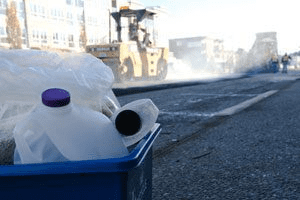
The benefits of using recycled plastic in asphalt are substantial.
Firstly, the city finally found a sustainable solution to reducing plastic waste in landfills.
Additionally, this technology allows for asphalt to be heated to just 40 degrees Celsius during the paving process, compared to the previous 160 degrees Celsius. This drastically reduces energy consumption.
Another major advantage is that road repairs using this new asphalt can now be conducted even in cold weather. As a result, emergency roadwork and traffic congestion caused by construction delays will no longer be common issues.
It is worth noting that the cost of this eco-friendly asphalt, which incorporates recycled plastic, is slightly higher than conventional asphalt. However, scientific and economic analyses suggest that the overall benefits far outweigh the initial expense. This asphalt significantly reduces the need for frequent repairs due to its enhanced durability, making it a long-term cost-effective solution.