

Park · Vancouver · ⭐ 9.3/10 · 3843 reviews · updated: 2026-08-04 20:18:40
Address: 3300 Victoria Dr, Vancouver, BC V5N 4M4, Canada
John Hendry Park (Trout Lake Park) — East Vancouver’s lake, market and meeting ground
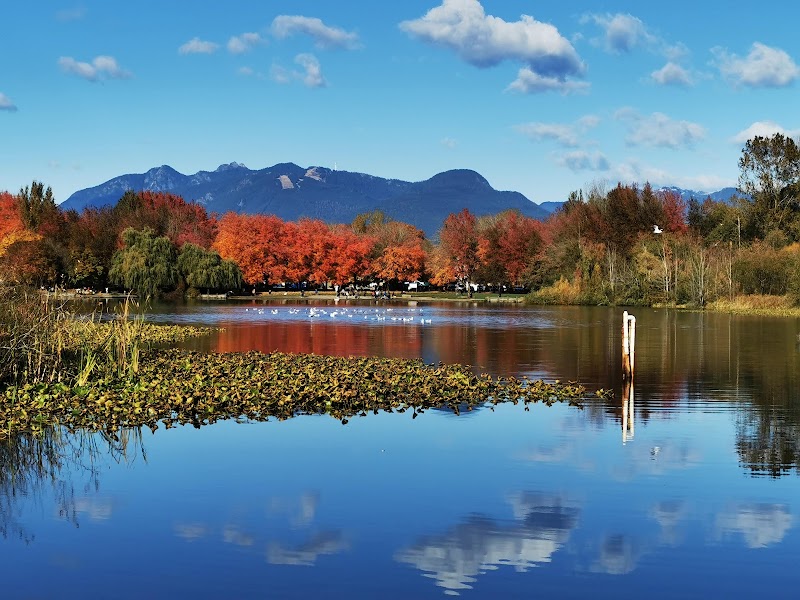
Almost nobody in Vancouver calls it John Hendry Park. To the neighbourhood it is simply Trout Lake: twenty-seven hectares of grass, cottonwood and open water in Cedar Cottage, wrapped around one of the few real lakes inside the city limits. On a Saturday morning the north end fills with market stalls and the smell of coffee and cut basil; by afternoon the fields are full of soccer, the dog areas are a churn of wet retrievers, and somebody is inevitably playing a drum under the trees. It is the least polished major park in Vancouver and the most used by the people who live beside it — a working park rather than a scenic one, and it has been at the centre of East Side life for a century.
Highlights
- Trout Lake itself — a shallow freshwater lake that began its recorded life as an industrial reservoir, feeding the boilers of the Hastings Mill through a wooden flume carried on a trestle from the 1860s until the Capilano water system took over in the 1880s.
- Trout Lake Community Centre and ice rink — rebuilt as a LEED Gold facility and opened in time for the 2010 Winter Olympics, when the new sheet of ice served as a figure-skating training venue; it still houses the rink, a gymnasium and multipurpose rooms.
- Trout Lake Farmers Market — the flagship of the Vancouver Farmers Markets network, running Saturdays from 9am to 2pm, April through October, with more than sixty farms, bakers and producers at the park’s north-east corner.
- The off-leash dog areas — roughly 26,000 square metres of designated off-leash ground, among the busiest in the city and one of the main reasons the park is full at seven in the morning and again at dusk.
- Sports fields and courts — soccer pitches, ball diamonds, tennis and basketball courts, used hard by school teams, adult leagues and pick-up games all week.
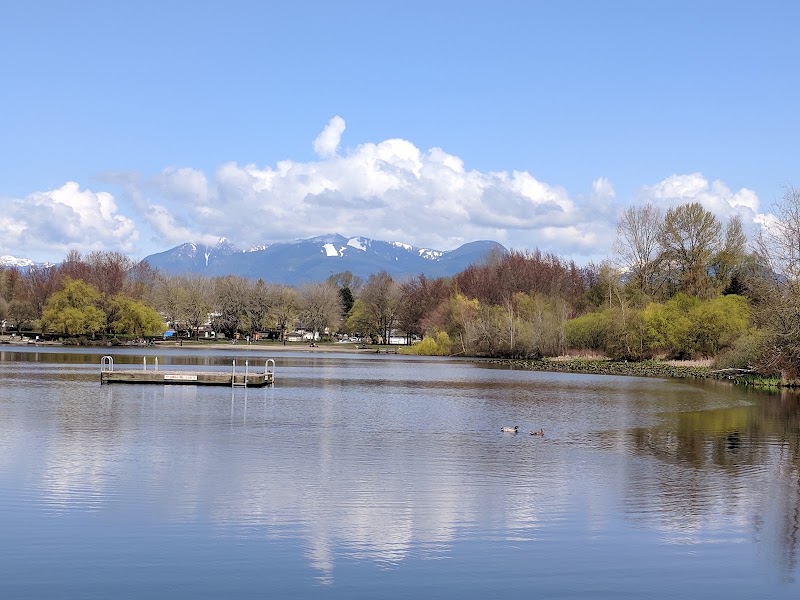
- The path around the water — a flat, roughly one-and-a-half-kilometre loop of gravel and grass with benches, a small dock and reed beds thick with red-winged blackbirds, dragonflies and turtles basking on the logs.
What you’ll find
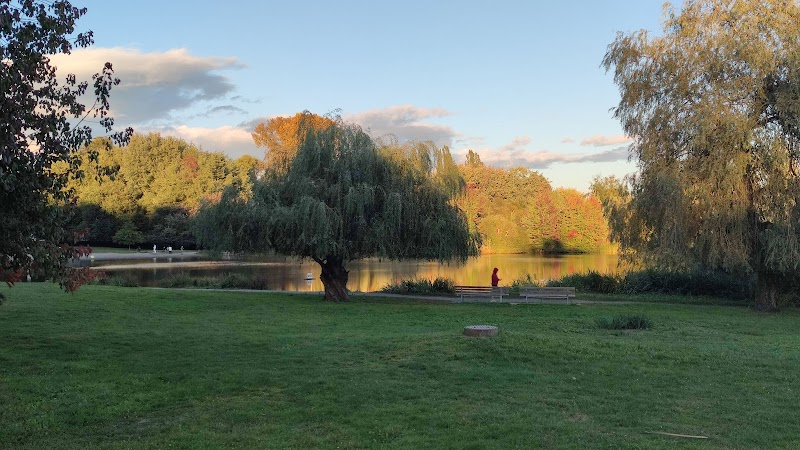
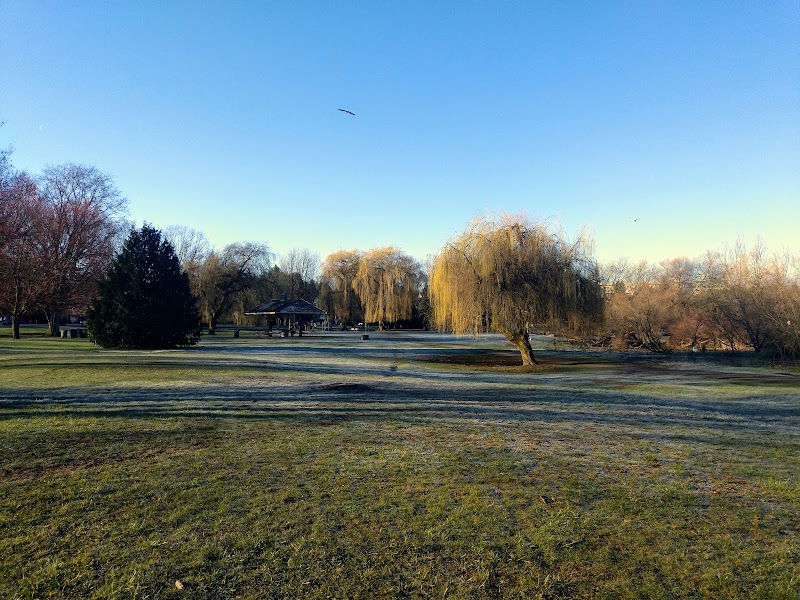
The park is arranged in bands. The lake and its marshy fringe occupy the middle; the playing fields spread across the flat southern and western ground; the community centre and rink sit at the south-west; and the informal, shaggier corners — dog areas, picnic slopes, the market site — fill the north and east. Nothing is manicured. Cottonwoods, willows and alders lean over the water, and the shoreline is deliberately being rewilded rather than tidied.
- Two playgrounds, including a large one near the community centre, plus swings and sand play for small children.
- Picnic tables, open lawn slopes facing the water, and a small sandy beach area at the south end of the lake.
- Public washrooms and drinking fountains at the community centre and near the fields.
- A network of gravel and paved paths, mostly flat, that link every corner of the park and connect out to the surrounding streets.
- The community centre building: rink, gym, fitness space, preschool and program rooms, run in partnership with a community association.
- Wetland planting and floating vegetation islands installed in recent years to filter and oxygenate the water as part of the lake’s rehabilitation.
Things to do — and who it’s for
- Dog owners — one of Vancouver’s largest and most social off-leash areas, with enough space that nervous dogs can keep their distance and enough regulars that yours will have friends by the second visit.
- Saturday food shoppers and cooks — the market is a genuine produce market, not a craft fair: root vegetables and berries in season, bread, cheese, eggs, mushrooms, cider and prepared food from local farms.
- Families with young children — flat paths for scooters and strollers, two playgrounds, shallow lakeside edges for duck-watching and a rink in winter, all within a few minutes of each other.
- Skaters and hockey players — the community centre rink runs public skating, lessons and league ice through the cold months, an unusual thing to find in a Vancouver neighbourhood park.
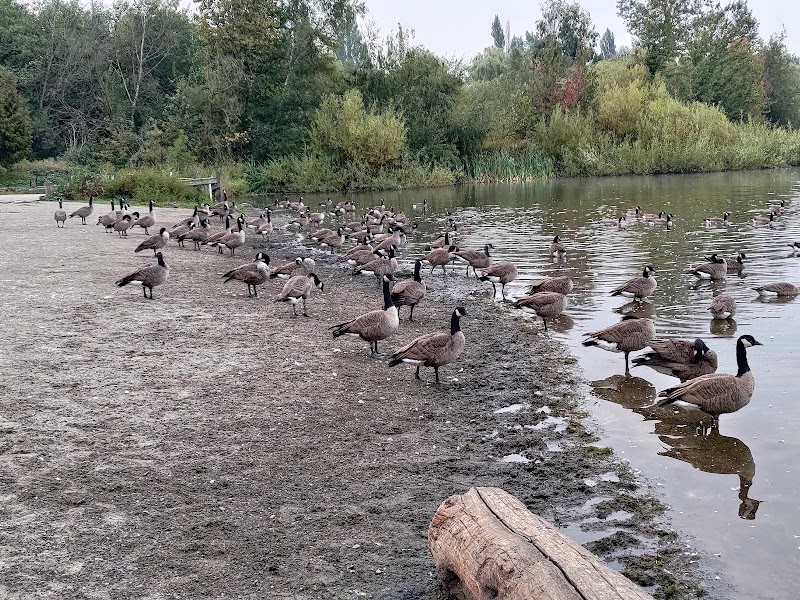
- Birders and quiet walkers — early mornings on the east shore bring herons, wood ducks, cormorants, bushtits and, in spring, a wall of red-winged blackbird song from the reeds.
- Team sport players — soccer, softball, tennis and basketball all have permanent homes here, and the fields are booked solid on weekday evenings from spring to autumn.
Getting there & practical
The park sits in Cedar Cottage on Vancouver’s East Side, close to the boundary with Kensington. By SkyTrain, Commercial–Broadway Station — served by both the Expo Line and the Millennium Line — is about a fifteen-minute walk away, and Nanaimo Station on the Expo Line is roughly twenty minutes on foot from the north-east corner. Bus routes 20, 7 and 9 all stop within a few minutes’ walk, and the night bus N20 serves the area after SkyTrain hours. Entry to the park is free and it has no gates; the community centre, the rink and registered programs are ticketed or paid separately, as is anything you buy at the market. The park is open daily from early morning until late evening; community centre and rink hours are shorter and seasonal, and the market runs Saturday mornings only, April to October. There is a parking lot by the community centre plus street parking around the edges, but on market Saturdays both fill early — arriving on foot, by bike or by transit is genuinely faster. Allow an hour for a loop of the lake, half a day if you are combining the market with a picnic.
When to visit
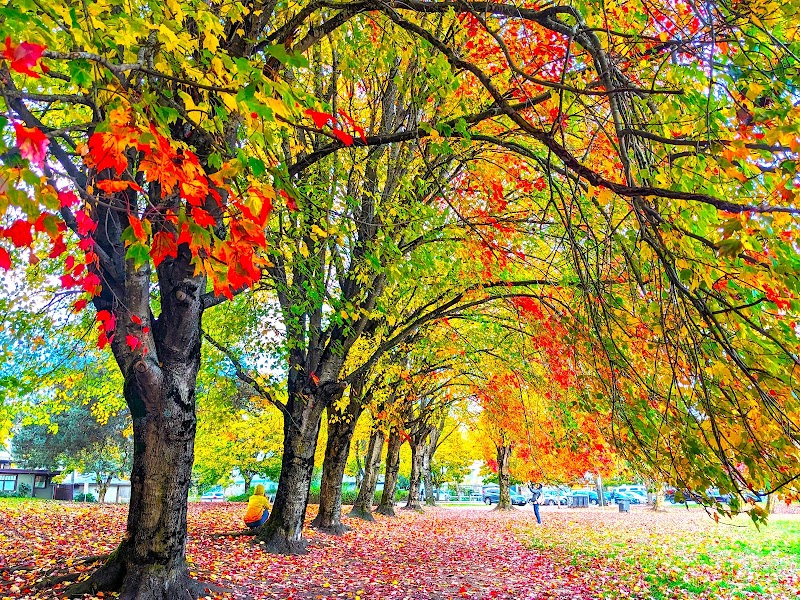
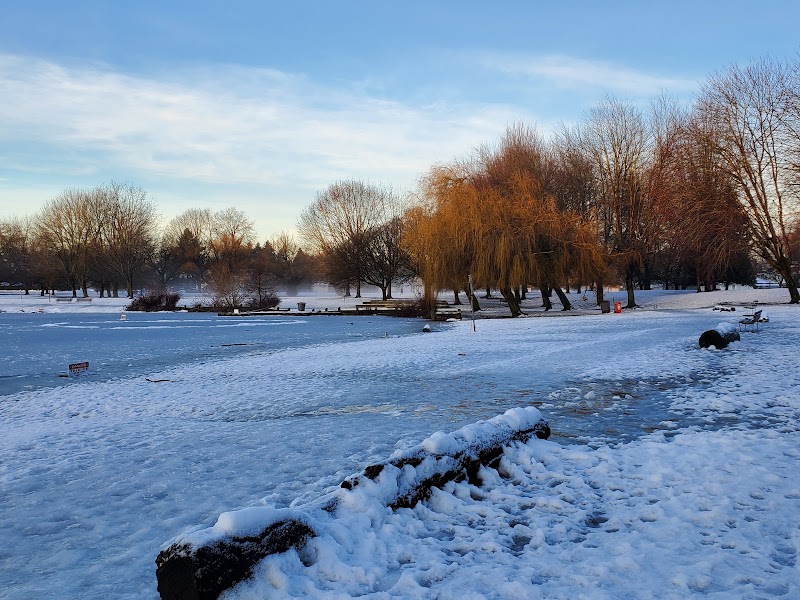
Spring is the park at its freshest: the cottonwoods leaf out, the market restarts in April, and the reed beds fill with nesting blackbirds. Summer is peak Trout Lake — long light evenings, drum circles, picnics on the west-facing slopes, the fields in constant use and the market at its fullest with berries and stone fruit; it is also when the lake is warmest and most closely watched by health authorities, so check the posted signage before letting anyone into the water. Autumn is arguably the best season here: the cottonwoods turn butter-yellow, the crowds thin, the market moves into squash and apples, and the light across the water in the late afternoon is remarkable. Winter in Vancouver means grey skies and rain rather than snow, and the park keeps working — the dog areas stay busy, the paths turn muddy, and the action shifts indoors to the rink, which is at its most atmospheric on a dark, wet January evening.
Good to know
The park’s two names carry its two histories. The lake was industrial infrastructure first: from the 1860s a wooden flume on a trestle ran from Trout Lake down an easy grade to the Hastings Mill on Burrard Inlet, supplying water for the mill’s boilers. The water was slightly acidic, which conveniently meant less scale and less frequent boiler cleaning — and beavers repeatedly dammed the flume intake, an early and very Canadian maintenance problem. The arrangement lasted until the city’s Capilano water system came online in the 1880s. The mill was owned by John Hendry (1843–1916), a New Brunswick-born lumberman who arrived in Vancouver in 1872 and went on to consolidate his holdings into the B.C. Mills, Timber and Trading Company, one of the province’s dominant lumber businesses. The mill closed around 1920. In 1926 Hendry’s daughter, Aldyen Hendry Hamber — married to Eric W. Hamber, later Lieutenant-Governor of British Columbia — donated the land to the Vancouver Park Board on the condition that it be named for her father, and John Hendry Park it officially became. Before that, in cold winters, the frozen lake had been a popular skating spot reached from the Cedar Cottage interurban stop. A field house arrived in 1951, the Grandview Community Centre in 1963, renamed Trout Lake Community Centre after a 1977 renovation, and the current LEED Gold building with its Olympic-legacy rink opened for 2010. The park is also a piece of Vancouver’s counterculture history: the Illuminares lantern festival, produced by the Public Dreams Society (founded 1985), was first held here in 1989 and drew tens of thousands of people carrying handmade lanterns around the lake at dusk; it moved to Canada Place in 2010, returned to the park in 2012 and closed with a twenty-fifth anniversary edition in 2013. The park still hosts pow wows, summer performances and the Halloween-season Parade of Lost Souls tradition. On water quality, be clear-eyed: Trout Lake has a long record of summer bacterial closures, and for years the Park Board topped it up with drinking water to keep levels up — an approach the Board itself has called unsustainable. The John Hendry Park Renewal Plan, approved unanimously on 16 May 2022 and the first comprehensive plan for the park since 1978, sets a twenty-year direction including stormwater management, creek daylighting, ending the potable-water top-ups and a full water-quality assessment running to the end of 2027. Renewal design work for the off-leash and north beach areas is underway with construction expected from 2026, and further park renewal sits in the 2027–2030 capital plan.
Visitor tips
- Come to the market before 10am on a Saturday if you want the good produce and a parking spot; come after noon if you want space to sit and eat without queuing.
- Bring boots between October and April. The lawns and the dog areas hold water, and the informal shoreline paths turn to genuine mud after Vancouver rain.
- Read the signs at the water’s edge before you swim or let a child wade. Posted advisories change through the summer, and the lake’s status is not the same from one season to the next.
Questions & answers
Can you swim in Trout Lake? Not as a supervised swimming beach. Vancouver’s Park Board confirmed in May 2026 that lifeguards would continue at nine outdoor beaches but not at Trout Lake, and the lake has a long history of summer closures caused by elevated E. coli. Vancouver Coastal Health samples the water weekly from May to September. Treat any entry into the water as unsupervised and read the on-site signage first — the briefing description of a lifeguarded swimming beach no longer matches the current situation.
Why is the water quality a problem? It is a small, shallow, largely enclosed urban lake with limited natural inflow, ringed by a dense residential neighbourhood and heavily used by dogs and waterfowl. Warm still water plus nutrient load equals bacterial spikes and algae. The city’s response is structural rather than cosmetic: floating vegetation islands, wetland planting, stormwater redesign, creek daylighting and an assessment running to the end of 2027.
Who was John Hendry? A lumber industrialist (1843–1916) who owned the Hastings Mill and built the B.C. Mills, Timber and Trading Company. Trout Lake supplied his mill’s boiler water. His daughter Aldyen Hendry Hamber donated the land to the city in 1926 and asked that the park carry his name.
When is the farmers market? Saturdays, 9am to 2pm, from April to the end of October, at the north-east corner of the park. It is the largest of the Vancouver Farmers Markets, with sixty-plus vendors, and it operates rain or shine.
Is the park dog-friendly? Very. There are designated off-leash areas totalling roughly 26,000 square metres, plus river-free open ground. Dogs must be on leash elsewhere in the park, including on the market site and the sports fields, and the off-leash boundaries are signed.
Does the ice rink belong to the park? Yes — it is inside the Trout Lake Community Centre at the park’s south-west side. The rink was built as part of the 2010 Winter Olympics legacy and was used as a figure-skating training venue during the Games. It runs public skating, lessons and league bookings; check the centre’s schedule, since ice time is heavily programmed.
How long does a visit take? Thirty to forty minutes for a loop of the lake at a walking pace, an hour if you stop. Add two hours or more for a market Saturday with a picnic, and a full afternoon if children are using the playgrounds or you are watching a game.
Is it accessible? Largely yes. The paths are flat, with paved sections around the community centre and the main approaches, and there are accessible washrooms in the centre. The informal lakeside trails are gravel and grass and can be soft in wet weather.
Photos
Show 1 more photos
Visitor reviews
Reviews last updated: 2026-08-04 20:18:40
Data is refreshed monthly. Sources: vancouver-name.com and editorial picks based on reviews.
This is a nice city park with plenty of parking spots around it. There's an off-leash dog area at the north beach.
The park at the south beach is open for swimming in the summer.
The views are beautiful all year round. I…
It's such a nice park, I met a good friend here today, there were plenty of free parking spots. All the cherry trees were already in bloom, the back side of the lake, where the wooden boardwalks used to be, was still a b…
A really nice city park with a view of the lake and the mountains to the north. It's suitable for all seasons. Either you need a quiet place for a walk, or you can bring your family along. It's also good for kids.
In the…
A very nice and wonderful place to spend a day. The beach is nice, and we saw a few people swimming, but the park itself is perfect for a leisurely stroll. We saw lots of happy dogs with their owners. My daughter and I w…
It's a beautiful park near the city, offering serene views and a peaceful atmosphere. Whether you're looking to go for a gentle walk, have a picnic, or just enjoy some quiet time by the water, this place is perfect. The…